Contact Centre Call Volume Forecasting Jamaica: Predict Demand Before It Overwhelms Your Team
Why Most Jamaican Contact Centres Are Always One Step Behind
Talk to any contact centre supervisor in Kingston or Montego Bay and they will describe the same pattern: Monday mornings are chaos, Friday afternoons are dead, and the week after Christmas leaves the team buried until February. They know it happens every year. When the spike arrives, they are still understaffed.
The culprit is not bad luck. It is the absence of a formal forecast. Most teams staff based on last week's gut feel or a manager's instinct, then react when volumes go wrong. Forecasting replaces that cycle with a plan built on numbers your phone system already captures — numbers you probably have not looked at in the right way yet.
This guide walks you through a practical approach that does not require a statistician or expensive workforce management software.
Call Volume Is More Predictable Than It Looks
Call arrivals can seem chaotic on any given day, but zoom out to a 90-day view and patterns emerge that are surprisingly consistent year over year. Most Jamaican businesses will recognise all of these:
- Day-of-week patterns: Mondays typically carry 20–40% more inbound volume than Wednesdays or Thursdays. Friday afternoons drop sharply after 3 p.m. as staff and customers alike shift into weekend mode.
- Time-of-day patterns: Most operations see two daily peaks — a morning rush from roughly 9 to 11 a.m. and a post-lunch surge between 1 and 2:30 p.m. Mid-morning is rarely the quiet period managers assume it is.
- Event-driven spikes: Bill-cycle dates, salary paydays, and public holiday closures generate predictable surges that a calendar can warn you about weeks in advance.
- Seasonal baselines: Back-to-school spending in September, the north-coast tourism peak, and December holiday activity all shift your baseline call volume in knowable, repeatable ways.
The key insight is that most variation in call volume is structured, not random. Once you can see the structure, you can staff for it.
The Data Already Sitting in Your Phone System
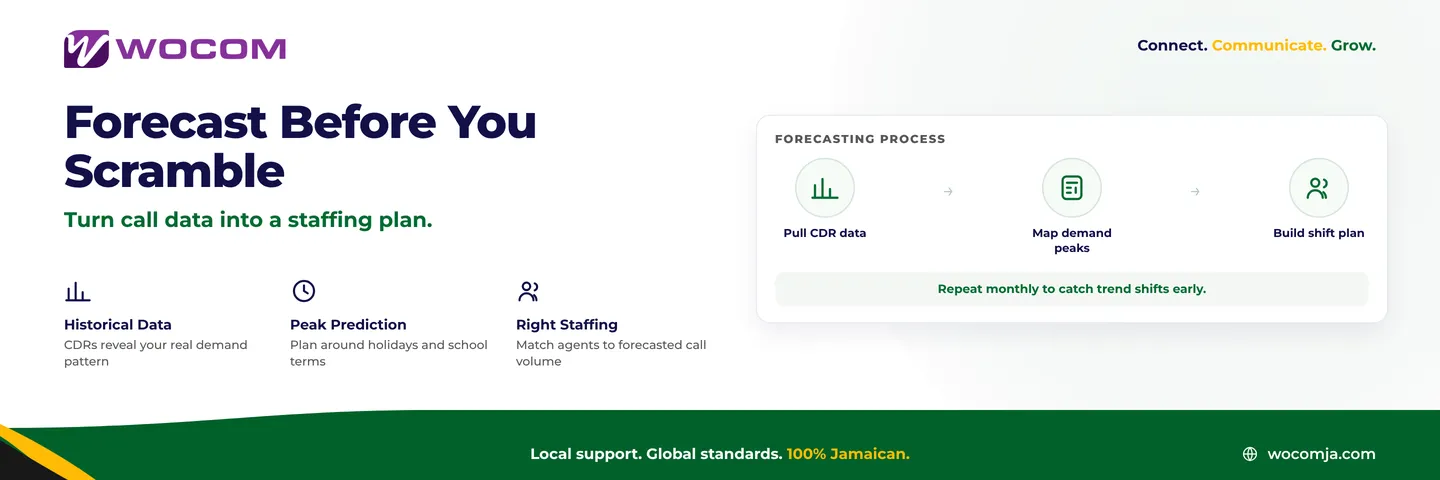
If you are on a cloud PBX or SIP trunk, you already have everything you need. Your call detail records — CDRs — log the timestamp of every inbound call, which means you can reconstruct a precise picture of demand for any period in your system's history.
From your CDRs, extract three things:
- Total inbound calls per hour, broken down by day of week. This is the raw demand signal.
- Average handle time (AHT) per call, including talk time and any after-call work. This converts call volume into agent hours required.
- Abandoned call timestamps. Calls that arrived but went unanswered represent hidden demand. If your system only logs handled calls, you are systematically under-counting how busy you actually are.
Most cloud PBX platforms let you export CDR data as a CSV file. If you are not sure how to pull that report from your WOCOM portal, the support team can walk you through the process in under ten minutes.
Building Your First Weekly Forecast
Start simple. Take your last 90 days of CDR data and group calls by day of week and hour. Calculate the average volume for each slot — for example, Monday 9–10 a.m. averaged 47 inbound calls across the last 13 Mondays. That average becomes your baseline forecast for the same slot next week.
To convert a call volume figure into a staffing number, you need three inputs: the forecast call volume, your AHT, and your service level target. A common target is 80% of calls answered within 20 seconds. Free Erlang C calculators are available online and will take those three inputs and output a minimum agent count for the half-hour block.
The goal at this stage is not perfection. It is getting a first forecast that is more accurate than gut feel. Even a rough model will immediately reveal whether you are chronically over-staffed at 2 p.m. or whether your Monday morning shortfall is larger than you assumed.
Accounting for Jamaica's Seasonal Demand
A rolling 90-day average works well during stable periods, but Jamaica's calendar introduces planned disruptions that need manual adjustment before they happen:
- August Independence and Emancipation holidays: Business-to-business call volumes drop, but consumer-facing and hospitality verticals often spike as people make plans or resolve billing issues before time off.
- Back-to-school (September): Retail, school-supply, and financial-services contact centres typically see a sharp uptick in the two weeks preceding the new term.
- December peak: Christmas shopping, end-of-year billing cycles, and staff annual leave combine to create the highest-stress month of the year. Start your December staffing plan no later than October.
- Hurricane season (June–November): A named storm or a significant weather event can generate two to four times normal call volume within 24 hours as customers seek information, report outages, or adjust appointments. This is not a forecast spike you can model — it is an emergency playbook you need ready before the season begins.
For each recurring seasonal event, apply a multiplier to your baseline forecast. If you have historical data, use it. If it is your first year forecasting formally, apply a conservative estimate and document the actual outcome so your model improves the following year.
Three Forecasting Mistakes That Will Undo Your Plan
Businesses that start forecasting often sabotage themselves with avoidable errors:
- Using only handled calls. If calls are abandoning before reaching an agent, those calls may not appear in your standard call count. Build abandoned call data into your demand figure from the start.
- Ignoring shrinkage. Your Erlang model tells you how many agents need to be on the phone simultaneously. Shrinkage — breaks, training, team meetings, sick leave — means you need to roster significantly more agents than the model output. For most Jamaican contact centres, a shrinkage allowance of 25–35% above the forecast requirement is realistic. Skip this step and your service level target is unachievable regardless of how accurate the forecast is.
- Updating the model only once a year. Call patterns shift. A new product launch, a change in your marketing approach, or a significant competitor change can move your baseline by 10–20% within a month. Review and rebase your forecast every four to six weeks, not annually.
Turning the Forecast Into Action
A forecast that sits in a spreadsheet helps no one. The output of your forecasting process should feed directly into three operational decisions every scheduling cycle:
- Shift construction: Which agents are on, at what times, and with what overlap to cover peak slots without paying for unnecessary coverage during quiet periods.
- Intraday triggers: If volume in the 10 a.m. slot runs 20% above forecast, what is the pre-agreed response — pulling agents from after-call work, activating overflow routing to another queue, or calling in a standby agent? The decision should be defined before the spike, not during it.
- Technology configuration: WOCOM Cloud PBX lets you pre-configure call queue overflow rules that activate automatically when wait times exceed a defined threshold. Mapping those thresholds to your forecast peaks means the system catches spikes your roster alone cannot absorb — without anyone having to manually intervene.
A call volume forecast does not eliminate surprises. It shrinks them. Teams that forecast well spend their energy improving service quality, not firefighting the same crisis every week.
Get Your Call Data Working Harder for You
WOCOM's cloud PBX and contact centre platform gives Jamaican businesses the reporting tools, call data exports, and experienced guidance to move from reactive staffing to a planned, data-driven operation. Whether you are running a five-seat team in Kingston or a multi-site contact centre with locations across the island, the principles and the platform are the same.
Speak with the WOCOM team today about pulling your first CDR export, reading your call volume reports, and building a forecasting model that holds up through your busiest periods. Visit wocomja.com/contact to get started.
Continue exploring
Ready to upgrade your communications?
Talk to our team about the right solution for your business.
Book a Demo Contact SalesEverett Kildare is WOCOM's voice and infrastructure specialist, with more than 25 years of experience designing and running carrier-grade voice, SIP and virtualization infrastructure. Holding a BSc in Information Technology, he has built, secured and migrated phone systems for businesses of every size. Everett writes WOCOM's technical coverage of SIP trunking, cloud PBX, contact centres, business continuity and migration.